
Most of what we read and hear about the presidential race is sound bites and wonkish analysis of what the candidates are saying. In doing research for an essay, I discovered an excellent series of articles that present what the candidates are saying in the context of their personal history and what they have said in the past. I recommend it:
The Next “Big Short”
As I left the Tropic Cinema yesterday (1/24/16) after being spellbound by The Big Short I was awash in mixed emotions. The  overall feeling was a profound sense of hopelessness. But mixed with it was a sense of vindication because my own assessment of how the real estate bubble happened was confirmed by the film.
I can’t honestly say that I saw it coming, at least not on my own. I happened to read an article about a couple of MIT guys who were predicting the crash and how their predictions were being dismissed by the real estate professionals. What those guys said made sense to me and squared with my own experience of booms and busts in commercial real estate.
My morose mood came from the sense that the collective self-deception and willful blindness that created the 2007-8 economic crisis was not cured by the ensuing bust. People continue to game the system. Eight years later the perpetrators are sharing a bonus pool that exceeds by a factor of two the total earnings of all those who work at or below the minimum wage. While the prosecution of drug dealers and petty thieves occupies most of the workload of prosecutors across the nation, the guys who erased about 6 trillion dollars of private assets haven’t missed a beat, or a meal, it would seem.
I see another one coming. Not housing this time but fossil energy. I earnestly hope that in eight more years I am not feeling angry about “The Big Short 2” describing how the energy industry savaged the land, water, and air before needing to be bailed out by the very taxpayers they steam-rolled.
Drilling companies are going bankrupt at an alarming rate. Twenty-six went belly up in 2015, up from five and six in the  preceding two years. Even mammoth Exxon’s drilling business is losing money. Why? Because the supply of fossil energy far exceeds the demand. The price of oil dropped below $30 a barrel. The price of natural gas will stay low for the foreseeable future. While we like the prospect of gasoline being under $2 a gallon, we know that global warming not only happening but it’s happening at an alarming rate. There won’t be a big resurgence of demand for fossil fuels without disastrous consequences.
But the energy industry doesn’t see it coming. The agencies that rate their stocks and bonds don’t seem to see it coming either. The great juggernaut lumbers on. Pennsylvania’s state government, has been working overtime to expedite the development of 30,000 miles of pipeline infrastructure to collect shale gas and deliver it to Philadelphia for processing into liquid natural gas (LNG). There are 9,000 fracked shale gas wells of which less than half are connected to collector pipelines. There are 16,000 more approved permits awaiting drilling.
Everybody in this voracious industry wants to make a killing before the music stops, and there are unwary banks and investors who will put up the money. As “The Big Short” so cleverly depicted with the housing boom, the various players will use guile and craft to shift the ultimate risk to others until the bubble bursts.
What then? Ordinary people (Donald Trump’s ‘losers’) will be left with farms and forests scarred by well pads, collector right of ways, pipelines, compressor stations, LNG refineries, all fallen into disrepair and abandonment because their owners are bankrupt or missing in action. They’ll be taxed to fund the sealing of leaking and dangerous orphaned wells. They’ll be experiencing first-hand the recently documented health impacts of methane and dozens of toxins brought to the aquifer and the air by the reckless large-scale perforation of the Earth’s surface.
As we see in The Big Short, there will be some guys and gals, a lot smarter than me, who also see it coming. They will short fossil energy at the right moment and become wealthy overnight.
For my part I have spoken at hearings of the PA Governor’s Task Force and the Delaware River Basin Commission. In the two minutes they allotted me I do little more that say “heads up” and point to the danger. Perhaps this is what each of us must do — just what little we can do — the next right thing. And pray that with Divine Assistance that little bit along with many others’ small but earnest efforts will eventually suffice. God Save America.
My Spiritual Journey
What follows is the presentation I was invited to make Sunday November 8th, 2015 at the Adult First Day School of the Newtown Friends Meeting. The audio recording includes both the introduction given by Norval Reece and the question and answer session which followed my talk.
~ Richmond Shreve
A few years ago, I wrote a short story based on climbing a 100-foot radio tower to repair an antenna connection. The structure was old and built like a tall, skinny version of the Eiffel Tower, a webwork of steel struts wide at the base and narrow at the top and held together with rivets. As I climbed, carefully tethering myself to the structure with a safety belt, it groaned audibly with my weight and vibrated and creaked in the gusty breeze that stiffened and shifted as I climbed above the surrounding trees.
I’m not a particularly courageous, and my imagination began serving up images of this old tower collapsing in a shower of rusty rivets. I paused in my climb to reconsider. But in that moment of fear a great calm came over me and I imagined a voice that said, “It’s not for you to decide when you die, just take it one step at a time.”
It was not so much a feeling of immutable destiny as a feeling that my life was in benevolent hands, and that I did not need to try to control what might happen, or fret about it, but rather do the next right thing. I think this is the essence of my relationship with the Divine. I don’t understand God, and I don’t spend much time worrying about fate. Yet I do seek to be discerning and prudent, to know what is knowable, and act with integrity.
My spiritual awareness has its roots in my childhood. As a boy of ten, I trained and served as an acolyte in the Episcopal Church my family attended. Father Whitcomb, the priest, was one of those grand old men who by his example models a true and lively faith. He was very traditional and wore a biretta, one of those curious little black hats with no brim and four raised peaks, and a large black pom-pom in the center. Although the Episcopal liturgy is complicated and involves dozens of practices and observances, Whitcomb time and again patiently coached me through the complicated ritual with whispers and gestures. Even at that young age, I understood that the ritual was a matter of respect. It was not something God required or ordained but was a practice that fostered one’s personal experience of reverence and worship. The “smells and bells,” the colorful vestments, the pomp and ceremony were a vehicle for, but not the essence of faith.
In recognition of my service as acolyte, Father Whitcomb fashioned with his own hands a simple wooden cross cut from black walnut he salvaged from a piece of discarded furniture. It has hung on the wall in every home I’ve had to this day.
In those early years, my sense of the divine was paternal. In my reckoning God’s love was like that of an unseen but benevolent father figure. My simple faith evolved as I grew to manhood. As an twenty-something Navy man, I joined a group of young adults who attended the 8 a.m. service at Grace Church Georgetown. We established a weekly practice of contributing a loaf of bread and a bottle of table wine for use in the communion service. There were only eight or ten at the service on any given Sunday, and it was far too few to consume the whole loaf of bread or the entire bottle of consecrated wine at the communion rail. After the benediction the surplus was carried to the Parrish hall where we all sat around a single table and ate and drank what remained as part of a leisurely brunch. It was, in my view, truly a communion – friends gathered for worship and fellowship. We liked to debate with the young priest. Our conversation usually centered on the homily preached at the service. We were, in every sense a community of faith and those breakfasts felt like spiritual food.
After my Navy years, I returned to college and met and married Lynne, my former wife. As an agnostic, she neither shared nor disputed my faith. We found common ground in the Unitarian congregation of Bridgewater, NJ. It was the ‘60s and among Unitarians I learned about and came to appreciate other belief systems. The diversity of that congregation challenged me to think outside of the frame imposed by the Episcopal credo and even the broader Christian traditions.
Joseph Campbell once addressed the matter of changing religions by likening one’s faith to a computer operating system: one should be cautious about switching because there are unintended consequences. My early Episcopalian experiences remain the foundation of my spiritual awareness, but my reverence for them is more nuanced now. I think organized religion is a path to authentic faith, but not necessary or sufficient.
Our great religions have evolved slowly over centuries. They represent a process of filtering and refinement that embodies the influences and perceptions of millions of seekers. The truth each holds sacred gets reinterpreted and refined as the contemporary context changes. It seems to me that we go wrong when we accept the myth and metaphor of a particular religious dogma as immutable unchanging truth rather than the provisional product of our ongoing quest to relate and be connected with a divine mystery. For me it’s not about seeking to understand analytically or to find THE ANSWER.
Those who insist they have it all figured out and know and understand absolute truth are the source of much of the world’s troubles.
The basic principles honored by the world’s great religions are love for one’s neighbor, and reverence for the divine. Many ancient religions call people to live a life apart, to form intentional communities with special rules and practices.
Marguerite and I knew each other socially for years before we became romantically involved and married. We were part of a circle of couples, close friends who met weekly with the express purpose of sharing experiences, becoming better parents and growing in personal depth. Lynne and I separated in 1977 and divorced.
Though our traditions differed, Marguerite and I shared a common faith premise. We attended the Plainfield Meeting and were married there on Thanksgiving Day in 1979.
On September 1, 1983, Korean Airlines flight 007 strayed into Russian airspace and was shot down. Marguerite, her son Mark, my Daughter Laura, and I, were supposed to be on that ill-fated flight. By God’s grace a last minute change of the tour’s departure date put us on the next day’s flight instead.
I’ve often had the experience of being spared both from chance misfortunes and my foolishness. They usually take the form of a pause, as if someone had tugged my sleeve, causing me to hesitate and avoid a mishap. You could call it luck, but I prefer to be thankful and call it grace.
A couple of years later, Marguerite and I were considering a vacation in Spain. I had a different impulse. I wanted to explore what gives a higher purpose to our lives. Being a typical tourist seemed self-indulgent and frivolous. To Marguerite’s surprise, I suggested that instead of Spain, we should return to Holy Cross Monastery in West Park, New York. Marguerite had a longstanding relationship with the brothers at the monastery.
In those days, the monastery kept “the great silence” from nine p.m. until after breakfast the following morning. However, just before 6 a.m. a brother would gently knock at each guest’s door and utter the greeting, “Let us praise the Lord.” The customary response was, “Thanks be to God.” Other than the prayers and psalms of the 6 a.m. Matins, those words of gratitude might be the only ones spoken in 12 hours. Marguerite and I have shared the practice of beginning the day with the words, “This is the day the Lord has made, let us rejoice and be glad in it.” No matter what else is going on, we have found it immensely helpful to approach the day with an attitude of gratitude.
I was particularly interested in what motivates monks to give up the freedom of independent life, marriage and family, and submit to the disciplines and institutional simplicity of the religious community.
While we were in retreat there, I made it my business to have long private chats with several brothers. Contrary to my expectations, they did not view their vocation with a sense of personal sacrifice or hardship. They actually liked being monks. Brother Bonnell “Bonnie” Spencer expressed it best. Though old and frail, his mind was sharp. He had spent much of his long life as a monk living, writing, and teaching in Liberia, Africa. He smiled and chuckled, saying, “I tried many things [before becoming a Monk] but none of them fit well. I simply discovered that being a monk was who I am.” The gist of his story was that the doors to other vocations were often closed, and his path was troubled and complex. But when he moved toward becoming a Monk the doors opened and the way was clear. As Quakers are fond of saying, “way opened” for him.
The other brothers shared different versions of the same story with me. In every case, they reported finding their authentic self in their vocation as monks. It was a positive, affirmative, and attractive choice for them – not at all the hair-shirt asceticism I had anticipated.
At one point, I talked with Brother Timothy Jolly about my own life. It was a long conversation, but it can be summarized by saying that I was concerned that many of my enthusiasms seemed to have no lasting importance. Compared to being called to live a contemplative religious life, my activities seemed rather trivial. I characterized the expense and self-indulgence of touring Spain, staying in luxury hotels, and dining in fine restaurants as pointless and superficial.
Timothy smiled and asked me, “So, what are you enthusiastic about?” I mentioned my work, interest in technology, ham radio, and other hobbies. Timothy said, “Did you know that the root of the word ‘enthusiasm’ means to be filled with God?” He went on to say that if we are doing what God calls us to do, it is usually joyful and gives rise to the feeling of enthusiasm. Frequently what we are deeply enthusiastic about is not easy, in fact it can be quite difficult and even frustrating.
I believe he was right. The pursuits I’m most enthusiastic about are rarely easy. But they are joyful and satisfying.
Some things are fun and provide relief from more demanding concerns. But such entertainment rarely makes a difference to others, and it seems empty when there is nothing of consequence to be diverted from. It’s the enthusiasm that sustains one through difficulty.
I just celebrated my 76th birthday. I have already lived my biblical three score and ten years and I enjoy a healthy, comfortable and secure retirement. God has been good to me.
These days, one of my enthusiasms is learning and practicing the craft of writing. I write both essays and short fiction. My websites rbshreve.com and nofrackingbucks.net contain more of my work than most of you will ever care to read.
In my life, I have been spared the worst of the suffering that I witness in other’s lives and the world. Much ink has been consumed attempting to explain the paradox of a loving God and the evil of the world. I was and am particularly perplexed by the many evil acts undertaken in the name of God. I am troubled by the horrors endured by innocents. I can’t help but ask, “How could a loving God, the paternal deity of my youth, the all-powerful force for good … how could God allow such suffering?” In the natural world, predation, disease, and chance mishaps are the norm. In human affairs, evil stubbornly persists. War, famine, pestilence, and death are always present somewhere on the globe.
I offer no answer. But I do know that each of us can find the good and evil of the external world mirrored in or own souls. Our acts and relationships are governed by our fears, our hopes, and our faith. These we have the power to shape. We can form ourselves, and is so doing influence our world.
I have come to believe that understanding God as an externality is the booby prize. The spiritual journey, the relationship we cultivate and live in with the divine is what gives our existence meaning. I need to understand myself and actively work on the spiritual process of my personal formation.
To live an examined life is an ontological design project. (Ontology is the branch of philosophy concerned with the nature of being.) Spiritual seeking is about crafting one’s soul.
David Brooks, the NY Times columnist, says we acquire depth of character through our experience and response to love, suffering, acceptance, and grace. We grow in depth to the extent we look inward and see ourselves with humility and objectivity.
So here I am, with most of my spiritual journey behind me. How do I describe the God of my understanding?
What I revere and name as God is the singularity of all that is, all that ever will be — the universe. Humans are unique among sentient creatures because our perceptions are not entirely hard wired, we learn to make new distinctions and through language we share them. We understand ourselves, our lives and circumstances by discerning ever more subtle differences.
I struggle with God’s singularity because I can’t get outside and divide it to understand it. My distress at the evil in the world is such a struggle. It’s a mystery, an open question: Why does the God whom I love and who loves me not simply ordain that the world be a peaceable and loving place? Instead, we seem locked in a constant struggle to bring order to chaos.
On the other hand, out of that chaos has developed the incredible, highly improbable, and utterly amazing organization and sustainability that you and I take for granted every day.
Since the very first spark of life on this planet, there has been enough of everything. Enough to sustain that life. Over millions of years life has survived and evolved in its wildly varied and exotic forms, replicating and innovating and culminating in a world populated by those like us who occasionally take time to ponder our individual contribution to the totality of all that is and all that is to come.
In my best moments, I see my very existence as miraculous. Here I am, a highly complex, self-aware organism with a heart that has kept beating for 76 years.
I perceive that against all odds, this chaotic world actually works for the most part or else we could not be gathered here in this peaceable meeting house sharing our wonder. Much of humanity has, in fact, learned to live in community and support one another. We’ve figured out how to rise above mere hand to mouth survival. We adapt the world to our needs. Albeit imperfectly, we learn from the past and we provide for the future.
Though I am a miniscule part of the vast totality, my life is not insignificant. My actions bear witness to my character and the depth of my soul. They inform the lives of others. In like manner, a long line of others stretching back in history also influenced me. My contribution, good or evil, will be communicated and transcend my life in the lives of those I touch. I’m forever a part of the Great Singularity, only temporarily a distinct individual, and what form my immortal self has will proceed from how I live the life I’m given.
In the fullness of time, I notice that all life optimizes itself. That which is destructive dies, and that which sustains us becomes part of what survives and prospers. So it is with what I share of myself in this life. My family and community will choose the best influences, perpetuating them while rejecting the rest.
My daughter Laura retells a story I once told her about my father. On an auto trip with our family, Dad abruptly made a U-turn and returned to the gas station where he had just filled the tank. He went over to the attendant and handed him some coins, saying, “You gave me too much change.” The amount wasn’t significant; it was a matter of personal integrity. Once he recognized his mistake, he had to set it right. Little did Dad know that one day, his granddaughter would pass the story to her children as a model of good character.
Earlier, I mentioned fear, hope, and faith. I see fear as negative faith, like the metaphorical darkness. Hope and faith are akin to the candle that dispels darkness. Much of the evil we experience is the fruit of fear.
The common fruits of fear are cynicism, distrust, anger, hate, alienation, violence, extremism, and isolation. Fear motivates survival responses of fight, flight, and selfish hoarding.
Hope and Faith are fear’s opposite. The fruits of hope are: vision, trust, peace, love, affiliation, empowerment and joy. The fruits of faith are: charity, courage, engagement, stewardship, empathy, gratitude and inner peace. Hope and faith motivate one to reach higher and venture more, to invest, to risk and to be generous and expansive.
I believe faith calls us to be prudent but not fearful, cultivating the attitudes of hope and trust in God’s ultimate benevolence.
A former business associate and fellow driving enthusiast was afflicted with a degenerative neurological illness that progressively sapped his strength and vitality and had no cure. As the disease progressed it confined him to a wheel chair and prevented him from racing his car on the track. He continued to attend our track events and helped organizers by serving as the pit steward. At one particular event I noticed he was especially upbeat and I told him it was great to see him looking well and enjoying the day. He said that some days were better than others, and then confided that recently he had been quite depressed, but that his mood was transformed by a vivid dream in which he imagined he called out in despair, “Why me?” A strong, clear voice replied, “I’m sorry, it’s nothing personal.” It was so loud that he said he looked to see if it had awakened his wife. He believed God had spoken to him in that dream, and he said from that moment, he felt at peace with his situation and decided to make the best of each day. He’s since passed away.
I’m grateful for my Christian heritage that superimposes a more comprehensible persona on God – a loving presence as the object of faith with a flesh and blood model for how one should live. I can’t love the cold abstract concept of a chaotic divine singularity.
Personally, I experience divine love in friendship. I believe we are called to be the channels of God’s love; some would say angels. We learn how to love in the fellowship of our families, spouses, children, and friends. If we are truly fortunate, we become part of a beloved community and experience the bounty of God’s love through one another – a communion of saints where the sacraments may be coffee and cake, or bread and wine, or a smile and a sincere, “How fares the Light with thee?”
There have been angels who intervened in my life. One was an interviewer considering me for a job shortly after graduating college. He had asked me about my education and I volunteered that I had flunked out of electrical engineering at Case Institute of Technology. I’d expected him to see my failure as a negative, but instead, he smiled and assured me that it was necessary to experience failure and learn from it. He said those who have never failed never really ventured enough to have their limits tested. The very thing I had felt ashamed about, he counted as a plus. He transformed my perception of myself with just a few words. He was probably unaware of this gift, a divine intervention of sorts.
I’ve experienced times when my interaction with someone has had that inspired quality, and I’ve watched transformation happen in someone else’s perception of themselves or their circumstances as I spoke. My part usually is a story I tell about myself. The conversation can be very intimate and intense. Often, I don’t know where the insight or the words I am offering come from. They just flow easily and the other person’s immediate resonance reveals that they are hearing just what they needed. In such moments, I believe I’m a channel for God’s grace, an unwitting angel.
Quakers are fond of saying that there is that of God in each of us. I’m convinced that it’s literally true, and that when two or more of us come together in that awareness we experience the presence of the divine. It is a profound blessing to be the messenger of God’s love to another human being.
I’m sure that in this gathering of Friends, it has not escaped your notice that the story of my spiritual journey has moved into familiar territory. You might choose words like “witness” and “testimony” to describe how God is revealed in a gathered meeting or in another person’s life journey. I am blessed to live with a woman of true and lively faith, a convinced Quaker, and a spiritual seeker. I feel at home in this meeting and perceive that the Religious Society of Friends is aptly named.
Thank you all for your kindness in being present here today and for indulging me with your attention.
Lobbying Congress: Civics 101
We usually would not want to be thought of as Lobbyists. The profession is not associated with strong ethics or high moral standards. Professional lobbyists are “hired guns” who sell their ability to gain access to those in power to the highest bidder. They are paid advocates, like lawyers, who seek to win the day for a client. Too often the question of what is best for our nation does not override the pursuit of billable time.
When 900 volunteers, all private citizens, invest their own time and money solely because they passionately care about the environment, it’s an entirely different sort of lobbying. None of us are registered lobbyists. We joined Citizen’s Climate Lobby (CCL) to protect our children and grandchildren from the disastrous effects of increasing the greenhouse gasses that blanket our atmosphere. It’s a problem that can only be addressed effectively by government. The purpose of Citizens’ Climate Lobby/Citizens’ Climate Education is two-fold: to create the political will for a livable world and to empower individuals to exercise their power as citizens.
The CCL conference was designed to train us on to meet with our legislators and their aides in an appreciative, clear, and focused manner and then to equip us with the supporting research for the proposed Carbon Fee and Dividend (CF&D) legislation. Armed with facts and “laser talks,” our teams of 5-6 citizen-lobbyists communicated with almost every Congressional representative and Senator.
Our teams generally included constituents, but not always. Because CCL members have earned the reputation of being respectful, non-partisan, and well informed we did gain access in all but a few cases. More about our experience in the meetings we attended later, but first a brief explanation of CF&D.
Carbon Fee and Dividend
We’ve all heard or read about “Carbon Tax” proposals that would levy a tax on any industrial product that contributes carbon dioxide or other greenhouse gasses to the atmosphere. The concept is not to unfairly tip the scales against fossil fuels but to put all energy sources on a level playing field, each paying the full costs of the energy it produces. Fossil fuels are “free riders” at present because prices do not include the collateral social and environmental and resource depletion costs. A carbon tax harnesses market forces to encourage investment and innovation in renewable energy technology, while reducing the use of fossil fuels year-by-year over a 20-year period.
The Carbon Fee we advocate would have this effect, but instead of the fee revenue going to grow government, it would be distributed directly to every American household on an equal basis. This dividend approach has many advantages over a tax:
• It offsets the incrementally rising price of fuel and other products that contain carbon for those who most need it. About two-thirds of US households, those in the middle and lower income brackets, would break even or be money ahead, receiving monthly checks of $288 for a family of four with 2 adults by 2025 and $396/monthly by 2035.
• It is not a “new tax” and thus is not repugnant to conservative Republicans.
• It allows market forces to accomplish the needed reduction of emissions, eliminating the cost and intrinsic unfairness of regulatory and enforcement action. (A $10/ton fee would cause CO2 emission to decline 33% after 10 years and 52% after 20 years.)
• It can be efficiently administered without adding layers of bureaucracy.
• It creates a net gain in jobs (2.1 million jobs in 10 years and 2.8 million jobs after 20 years)
• It stimulates the economy, increasing GDP by $70-$80 Billion from 2020 on, with a cumulative increase due to CF&D of $1.375 Trillion
• It saves lives (13,000 lives per year after 10 years due to the drop in CO2 and other greenhouse gasses)
• It allows businesses and investors to adapt to and plan for the new energy environment, allowing for incremental, systematic change by starting with a low fee ($15/ton) and increasing $10/ton each year for 10 years.
These legislative advantages appeal to both progressive and conservative values. Both sides of the political divide could and should get behind this approach. But how do we know it can deliver?
Econometric Modeling
Regional Economic Modeling Inc. (REMI) is a company that has developed a model for projecting the economic impact of policies and events. They work for businesses, nonprofits and governments and don’t skew their findings to please their customers. CCL commissioned them to simulate the effects of implementing a $10 per ton at-the-source fee on carbon adding yearly increases of $10 a ton. The model tabulates the changes from the baseline (doing nothing) so that we see what effect the carbon fee has on Gross Domestic Product, jobs, income, etc.
In addition to the national predictions mentioned above, the model projects the effects on smaller geographic areas so that a Congressional representative can see what the impact on his or her constituents would be.
Devilish Details
Over the past four years the Carbon Fee and Dividend idea has been thoroughly discussed and debated to identify objections and address them. We were impressed at the research that has been done to answer both obvious criticisms and narrower local concerns. The work is summarized in a series of briefing papers. By internalizing the content of these laser talks, we CCL volunteers were able to address objections with confidence, and if a question arose that we couldn’t answer, we were equally confident that it can be answered in a follow-up communication.
Though not all of us were fully conversant with all of the laser talk materials, someone on the team could usually respond to questions. This allowed us to pitch our idea convincingly, and make our request (the “ask”) in a powerful and professional way.
Our Personal Experience
What’s it like to be a citizen-lobbyist? Individually most of us couldn’t have pulled it off, but in our teams, it was exhilarating, eye-opening, deeply satisfying—and surprisingly inspiring. CCL had recommended we asked fellow constituents who couldn’t come to Washington to make a phone call the day before we lobbied saying, “I support action on climate change, and I want to see Congress do something about it,” and, if they agreed, to also mention their support for the proposed Carbon Fee & Dividend legislation.
Each member of our team had an assigned role so that we stayed focused and used the time we were allotted effectively. The staffers (mostly talented, smart, politically savvy people in their 20’s-40’s) received us respectfully, asked good questions, took notes, and represented their understanding of their elected officials’ position which could range from “climate deniers” to “enthusiastic change agent.” If they couldn’t (yet) support CF&D, we came prepared to make a secondary ask that would allow them to consider a smaller step.
Our timing was the best. The Pope released his long-awaited Encyclical on Climate Change the week before we arrived in Washington. We also had a book of “faith-based” statements on Climate Change that represented the spectrum of reasons that different religions had for supporting action on climate change: “care for creation” to “seeking environmental justice” to “threat of global warming/climate change” from all branches of Christianity, Hindus, Islam, Judaism, Native Americans, and ecumenical and inter-faith groups. There were also massive thunder, lightning and hail storms the day we arrived and the day we departed.
Now we’re home, tired but gratified by the experience, armed with plans to follow-up when our members of Congress return to their home districts on break, while we citizen-lobbyists return to our homes, our children, our jobs, our lives.
We know our work isn’t over until Carbon Fee & Dividend becomes the law of the land. But the experience of walking the halls of Congress and meeting with the people who make our laws gave us renewed faith in our capacity as citizens to influence government. It was, for us, the lab course for Civics 101.
What do Quakers (Friends) Believe
Acquaintances often ask me what Quakers believe knowing that Marguerite is a Quaker and that I have been attending First Day meeting with her for years. You won’t find an official creed that Quakers subscribe to. The reasons are rooted in history, but remain central to the Quaker notion of the Divine or God.
Most believe that there is “that of God” in every person, and that our relationship with the Divine is immediate and personal. No intermediary is necessary to hear the leading of God, and no other person or thing is essential to mediate our connection with the divine. One needs only to sit quietly listening and waiting with openness to the Spirit moving you. In fact, priests, liturgies, vestments, ornate churches, and the other traditional trappings of formal religions get in the way by substituting the external for what must arise from within. So, while individuals may share what they personally believe, they don’t presume to speak for all Quakers.
That said, here are some attempts to describe what Quakers believe. The first is a set of nine statements that life-long Quaker Arthur Larrabee has constructed and revised over many years of conversations with his fellow Friends.
The second item is a simple list compiled and offered by the Friends General Conference – the organization that serves Quaker Meetings throughout the US and Canada. It’s generally given to visitors who wish to explore what the Religious Society of Friends stands for.

Rack Cards Summarizing Friends Values and Testimonies.

Quaker Beliefs

Quaker Testimonies
The Defense Monitor
Much of what we read in the media about defense is politicized, and can even be laced with deliberate dis-information. The Center for Defense Information has been around for nearly 40 years and was founded by retired military.

I have been a long-time supporter of CDI – at least 20 years. Under Adm. Gene LaRoque and Adm. Eugene Carroll it was a reliable source of fact and sober analysis. I became disappointed in the direction it took a few years ago with Bruce Blair as Director because it became more opinion and case-building advocacy – just another shrill voice among many. Recent issues seem more objective and balanced so I ‘m once again a reader.
Military spending is far and away the most burdensome part of our federal budget for taxpayers. The amount of waste is astonishing and it defies all efforts at reform. CDI is one place to go for objective, fact-based reporting and analysis.
Team Viewer
Ever wish you could look up something on your home computer when you were away? Want to help a friend do something on his/her computer without either of you leaving home?

You can easily add those capabilities to your PC, Mac, iPhone, iPad, etc. by downloading the “free for personal use” software from Team Viewer. It couldn’t be much easier. Once you have registered on the Team Viewer website (also free) you will be able to link your computer to any other computer running the software. If it’s one of your own computers registered to your account, you’ll be able to access it over the internet without anyone’s help.
However if you are connecting to someone else, then they must provide you with a password for that session. Once connected you can do pretty much anything from your computer that they can do at the keyboard themselves.
In addition to the obvious collaboration and support possibilities, Team Viewer also allows for conferencing via computer.
Check it out:
TeamViewer.com
“I’m from the IRS …”
The caller says she’s from the IRS and demands that you call back. It sounds menacing, but it’s just another telephone scam. I recorded the one I received on May 1st, and you can listen here:
Here’s what you can do.
- Take notes of what’s said. You’ll need them to report the scam.
-
Give no information about yourself.
-
If you have caller ID, enter the phone number into the search window of your web browser. There are several websites that provide reports on phone numbers that originate scams. I like Report The Call and 800Notes.
-
Report the scam to the Federal Trade Commission. Here’s the website: FTC Complaint Assistant
If it’s a phony IRS call also report it here: www.tigta.gov.
What if you think it’s a legitimate call but aren’t sure?
Take down the caller’s name an phone number and offer to call back later. Go to the official website of the company or government agency and get the public phone number there so you are sure you are not calling an impostor. Call and ask for person who called you or explain that your are trying to validate a call you received.
People working these scams will generally cut you off and hang up when they know you are suspicious. Legitimate callers don’t mind that you are being cautious.
Faith
Faith
Although faith is intangible, and not linear or rational, it profoundly affects how people act as individuals and as communities. A true and lively faith energizes and motivates. In this essay I’m exploring how our faith is a force in our lives; and how its power can be both positive and negative for individuals, communities, and society.
There is an important difference between religious dogma and faith. It is possible to identify with a religion and not have faith. It is common to have faith and not be religious. I am a Christian by tradition and upbringing, and an Episcopalian by affiliation. But in everyday practice the Quaker values best match my personal beliefs and spiritual aspirations.
Most Christian denominations use some version of the Nicene (Apostles) Creed to summarize what they profess to believe. Members often recite the creed in unison as a part of their worship liturgy, but there is a wide range of personal interpretation that ranges from rigidly literal to a more flexible and metaphorical take when it comes to what the words are understood to mean.
By contrast, Quakers cherish the personal process of seeking a faith relationship to the Divine. Individuals may not agree on specifics, but generally agree on what a living faith looks like when translated into action. One’s life choices testify or witness to their faith.
Quakers are inclusive without being evangelical. They won’t ask you if you are “saved” or pretend that their beliefs are superior to yours. It’s common for people to attend Quaker worship for years without ever being asked if they wish to become Quakers. Members of the community are generally open and interested in how you personally experience God. Indeed, adult religious education is often simply a talk given by one person about his or her faith journey. One doesn’t simply declare themselves to be a member of the Religious Society of Friends, a committee will interview a person who expresses the interest. The purpose of this interview is to discern if the person is actively seeking to discover a personal relationship with the Devine.
Quakers value simplicity, integrity, industry, community, stewardship and peace. They generally eschew traditional authoritarian organizational processes. They govern their congregations or “meetings” by consensus – often a time consuming and frustrating process for those used to decisive executive power or governance systems rooted in Robert’s rules.
Formation
We aren’t born with beliefs or knowledge. As infants we are utterly dependent and totally self-centered. Our experience of the world begins at birth and possibly a little before. Our brains and bodies continue to develop rapidly for about 16 years, and more slowly thereafter. Our intellectual and spiritual growth need never stop.
What makes human experience unique is our capacity to acquire and share the experience of others through socialization and language. Every generation builds on the traditions and discoveries of its forebears. So each of us is born into a rich environment of knowledge and belief that becomes a context for our lives. Lab rats learn to run a maze by trial and error, but can’t tell the next rat how.
We humans can and must learn to imagine, to think in the abstract, to anticipate consequences of choices, and to envision future possibilities. The vehicle or mechanism for this is our stories. In our most “primitive” societies myths evolve that metaphorically transfer the background culture to children. Parents and elders show and tell to convey the skills of life to each new generation. Shared traditions bind a people together and enable them to cooperate and coordinate for the common good.
Much of this learning becomes accepted as obvious, an invisible structure of basic assumptions. We unconsciously respond to these fundamentals as animals respond to instinct.accepted and customary set of beliefs and premises that are not reexamined or even thought about.
A True and Lively Faith
We all know faith when we see it, but might be hard pressed to define it in words. Like love and beauty we must experience it rather than be told about it. We see people do things that are testimonies to their faith.
We judge the spiritual tree by its fruits.
Machines that Think
When I was a kid in high school sixty years ago the transistor had just been invented and transistor radios were a novelty.  In 1960 when I graduated from the US Navy’s Electronics School they devoted only one week out of 28 to the transistor “because you might run across them someday” in the military gear we were being trained to maintain. It was only a year or so later that I was beginning to see transistors in super-secret cutting-edge gear.
In 1966, working for Gates Radio Company, I was selling broadcast quality stereo sound mixers with all the glowing vacuum tubes replaced by tiny transistors. Yet our vacuum tube powered computer still filled an entire room and was controlled with stacks of IBM punch cards. There was a staff of several people that kept it running 24/7.
A few years later in 1979, a young statistician working with me in my marketing research department at Sandoz began using the first Apple computer for survey tabulations, bypassing the company’s lethargic and bureaucratic IT department. We got better results faster and the move heralded the demise of the “big iron” computer for our sort of work. One guy with a spreadsheet program could do what had previously taken an organization of highly skilled people weeks to do.
Today spreadsheets and word processors are standard personal computer applications. Now the latest “gee whiz” tools are vastly more sophisticated. For example, I can design and test complicated electronics gadgets using a four dollar app on my iPhone. Engineers at electronics design labs, using industrial versions of this software, can complete a design, test it and improve it in the simulator part of their software, and then submit the perfected design to the lab for fabrication. The working physical prototype device composed of thousands of tiny transistors and component parts is “printed” and delivered back to the design engineer in a matter of hours – virtually untouched by human hands.
Accelerating Change
Dramatic, isn’t it? The computer went from being a mechanical toy to a ubiquitous tool for commerce and science. It truly is amazing. Various technology leaders have been following the trend that was born at the beginning of my career. It is accelerating fast, and it will continue to change the very nature of human vocations. Electronics technicians who actually work with soldering irons and components are a vanishing breed. Radio Shack is in bankruptcy. Amateur Radio is a vanishing hobby. Most electronics are disposable and it is hard to find a real TV repairman. The cable guy is a mechanic with little or no knowledge of how the wires and boxes he installs actually do their magic.
Tool or Threat?
A long-time friend and business colleague made a sweeping gesture toward a mostly vacant cluster of office cubicles saying, “See that? I don’t need half the people I once did. Nobody in my executive staff has a secretary.” He pulled out his smart phone. “Don’t need one. This does all that – appointments, meetings, mail, reminders.” Pausing, he shook his head and his voice became grave, “Don’t look back over your shoulder, there’s somebody who will do your job better, faster, and cheaper than you.

He’ll work twenty-four seven, doesn’t need benefits, doesn’t get tired, doesn’t take days off.” He patted the pocket where he’d put the phone. “It’s coming.”
For my friend, the smart phone was a tool but he could see the threat, and for the clerks and secretaries he once employed, it was a jarring career change.
It was the 2007 recession that forced his downsizing, and technology filled the voids. That trend continues. I am a reasonably fast touch typist. I still prefer to compose at the keyboard, but I don’t have to. I can dictate my words onto “tape” or directly into my computer. The voice recognition software I use types faster, spells better, and is more accurate than I am. Only because I share an office with my wife, and the sound of my dictation distracts her, do I continue to type for myself.
Clearly technology will continue to eliminate human jobs that involve repetitive routines or processes. In other work it will reduce the level of skill needed. In college I learned drafting with a pencil and T-square. I had to acquire the skill to visualize three dimensional objects in two dimensions, and to draw lines of various thickness and weight to visually represent them. Today, computer aided design or CAD has made the old butcher-block drawing board obsolete. I have another four dollar program on my phone that does excellent drafting, no manual skill required. I also have programs that let me create beautiful graphics with photos, illustrations, dramatic fonts, and render them as press-ready posters, banners, postcards, etc. I’m not a career commercial artist, but my hi-tech tools let me do professional level projects. And yes, the tools continue to evolve.
Machines that Think
The Washington Post published an article headlined, “Apple co-founder on artificial intelligence: ‘The future is scary and very bad for people.’”

Wozniac joins others like Gates, Jobs, Hawking, and Musk in this view. Ordinary work for people is becoming obsolete. The industrial revolution of the 19th and 20th century led to an era of leisure for the common individual in industrialized societies. A person could work a 40 hour week and have evenings and weekends free, enjoy paid holidays, vacations. Children didn’t need to work to help support the family. Where once only the rich had time for education and the arts, a large middle class gained access to affluent lifestyles.
Will human creativity be immune to the relentless assault on human vocations? Maybe not. Consider the musician’s new tools. Electronic synthesizers allow a person with piano keyboard talent to simulate a huge repertoire of instruments. Percussion, strings, woodwinds, brass, as well as other-worldly electronic tones are all available. He or she can create and save a continuous loop of sound to produce the background rhythm of drums, then add another loop or two that supplies the bass beat, and then improvise a melody.
The “one man band” has come a long way in recent years. Barbara Streisand, with four talented musicians using these tools produced the sound of a full orchestra and simulated the acoustics of a great concert hall – all in the coziness of her home garden. And yes, similar music tools are all on my iPad.
I have no musical training at all, but I can craft New Age sounds and harmonies by drawing patterns on my touch screen computer. With little effort except to discern what sounds good to me, I can make music, save it, and play it back at will. Yes, the computer can render my humble effort as a printed musical score, even though I can’t read it. If I write lyrics, it will translate into any of several languages as well. How much of a leap will it be for a computer to anticipate what will sound good, and generate original music and arrangements?
It is easy to imagine that computers could analyze the elements of the most popular music, determine what is most likely to please, and generate new tunes.
Networks of Machines
The internet has not only enabled us to instantly communicate with far flung networks of friends, but it has also allowed networks of machines to communicate and coordinate with each other and become the Internet of Things (IoT). These networks are ubiquitous and largely invisible to the average person. I’ll point out a few.
Aircraft
Commercial airliners have sophisticated autopilots that are capable of flying the plane from shortly after takeoff and actually landing it at the end of the trip. These systems also detect pilot error and sound warnings when not actually controlling the plane. The automated systems within the plane can take into account all of the variables: engine performance, air speed, ground speed, altitude, heading, control position, etc. A computer processes this information and optimizes for efficiency and may even anticipate and compensate for changes that affect the smoothness of flight. The aircraft interacts with Global Positioning Satellites (GPS), radar systems, and ground control so that it “knows” the position and course of other aircraft and even weather systems. During final approach and landing the aircraft gets feedback from ground systems plus its own systems to adjust for deviations from the correct glide path. We are not all that far from having aircraft that can fly themselves better than humans can. What’s missing is the ability to deal with the unexpected emergency in the creative way a seasoned pilot must. But how many pilots will still have the necessary skills if they seldom actually fly the plane “by the seat of the pants?”
Cars
We already have cars that can parallel park themselves better that most humans. Google and others have been experimenting with self-driving cars with considerable success. But unlike aircraft, the auto must deal with road hazards: debris, potholes, animals, children and other pedestrians, rain, snow, ice, and impaired human drivers. They will also have to win the confidence of human passengers and government regulators.
Yet autos already have some advantages with more to come. The anti-lock brakes (ABS) on virtually all current models of cars can stop a car faster than even an experienced race driver because ABS applies the maximum stopping traction to each individual wheel, automatically adjusting for changes in traction due to road surface. The race driver must apply pedal pressure just short of locking the wheels. Often one wheel locks briefly despite skillful braking. On an eighteen wheel semi, no amount of driver skill can prevent lockup. ABS reacts faster and is more adaptive than humans can be.
We can now buy systems for cars that warn when we are closing on another vehicle or obstruction too fast. But before long cars will be equipped with wireless networking that will power an ad-hoc network in which each vehicle can be aware of the location, speed and direction of its neighbors on the road. Such a network would allow the auto to “see” around corners, over hills, and through rain and fog. It’s easy to imagine that these smart cars could also communicate with the traffic signals and a highway network to allow traffic to synchronize speed taking into account conditions not yet visible.
In such a system, vehicles could move like a flock of birds in close formation without danger of the sort of pileup collisions seen on today’s freeways. The day may be coming when it’s not legal to pilot your own car on high speed roadways.
Banks
I never visit my bank. It’s in San Antonio, Texas and I live in Newtown, Pennsylvania. If I want to deposit a check, I snap a picture with my phone, select the account, enter the amount and the bank reads digital codes on the check image, and credits my account. Somewhere in the process a human must view the image to verify the amount, but even that may soon be automated.
Machines communicate with each other to make these transactions possible: my phone sends data over the internet to my bank’s computer and the bank authenticates me and my phone. Then the phone interacts with the bank computer to validate the check image as readable. Finally the banks computer acknowledges the transaction to my phone and the phone displays the new balance. I can pay bills in much the same way. My bank in turn uses the Automated Clearing House (ACH) network to process the check with the issuing bank and move the funds. All of this is machine talking to machine.
Artificial Intelligence
Actually the forgoing examples are not artificial intelligence; maybe we could call them artificial skill systems. Intelligence implies the capacity to learn, create and adapt – that is to think autonomously. The capacity to transfer learning by language, to anticipate, and to adapt ourselves proactively sets us apart from other life forms and from the machines we have thus far created. Frankly, we have a lot to learn about how our human brain and nervous system works to enable us to think.
Pure logic and analysis alone do not suffice. Humans who lack compassion and emotional affect are regarded as psychopaths – deficient in qualities essential to socialization.
The fictional Mr. Spock, portrayed by the late
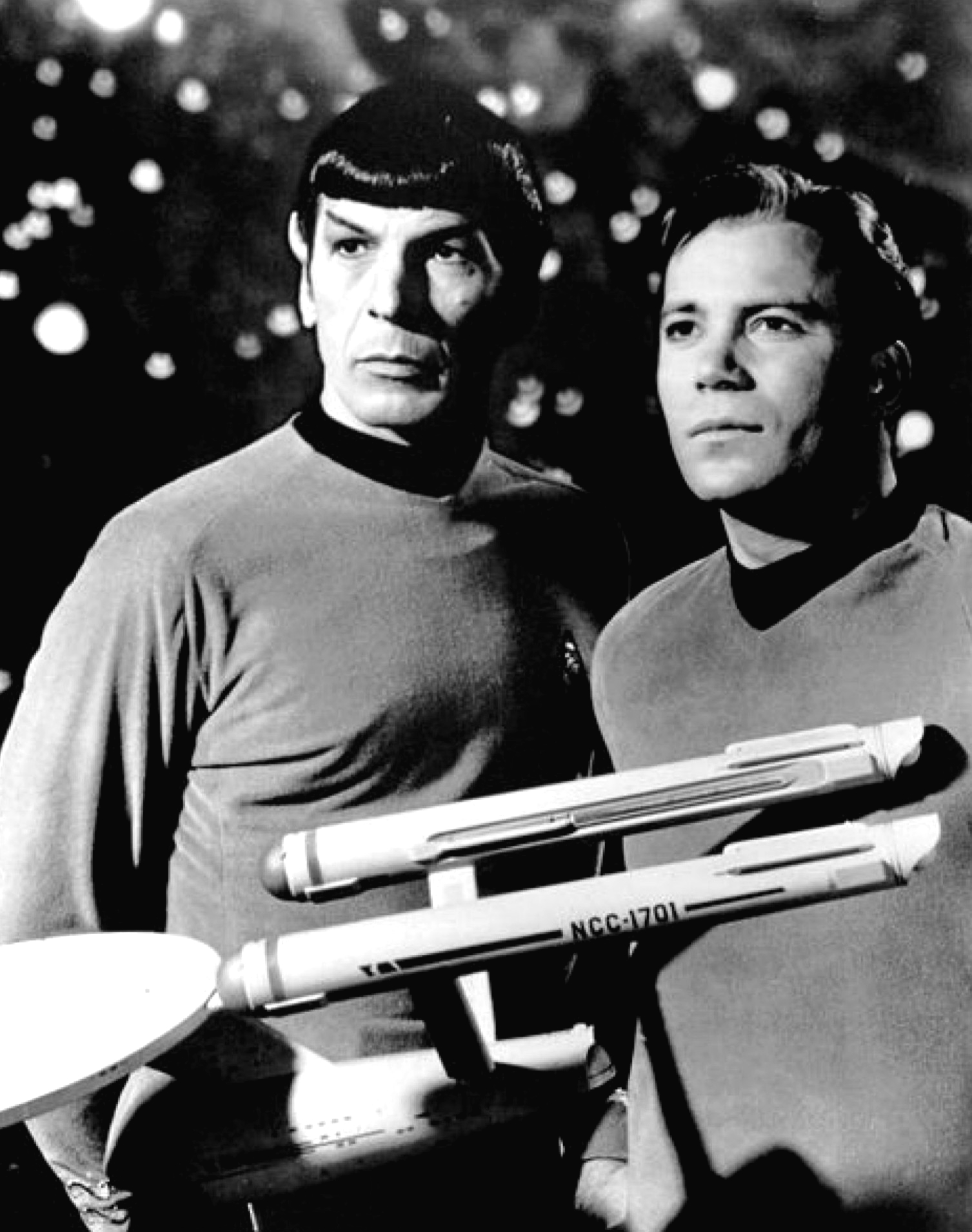
Leonard Nemoy in Startrek, was a character who functioned rationally lacking the human emotions of his crew mates. The Doc Martin character, of the British TV comedy, seemed to lack the ability to fully experience or express emotions – a flaw that is the source for the hilarious situations that have entertained viewers for several seasons. These two fictional personalities dramatize the huge difference between he purely analytical/logical and actual human thought.
That’s not to say humans can’t be fooled by machines. In June 2014 a computer dubbed with the name Eugene Goostman succeeded in passing the Turing test by fooling more that 30% of the humans who interacted with it into thinking it was a human.
Technology and the Internet have evolved to assemble, organize and retain knowledge. But can’t (yet) synthesize new facts and theories. It has evolved to execute complex processes including many that once required skilled human craftsmen. The graphical user interface (GUI) combined with voice recognition allows humans to interact directly, as if with another human. A familiar example is Siri, the iPhone application that interprets human speech to look up information and execute requests. If you ask Siri, “Do you love me?” she responds, “I respect you.” It’s the programmer’s sense of humor, not the computer’s. Even Siri is not intelligence, it’s just another human to machine interface.
Scientists are experimenting with machines that mimic neural networks and it looks like they will succeed. Indeed there is a branch of statistics, Artificial Neural Networks or ANNs, that is inspired by biological neural networks. This science is applied in creating the computer software that powers voice and image recognition systems. ANNs will be the fundamental building block for genuine artificial intelligence. When such networks can autonomously adapt themselves and self-replicate to extend and enhance their functions, then the dividing line between biological and mechanical intelligence will begin to blur. Just this week Amazon announced the availability of a product for software developers that makes AI tools for machine learning affordable.
If we now have excellent voice recognition systems, reliable image and fingerprint recognition, and computers that can fool people in conversation, is it so hard to imagine genuine artificial intelligence?  A newly released film, Ex Machina, contemplates the consequences of simulating a flesh and blood woman named Ava. She, another recent film contemplates a computer operating system that so realistically simulates human behavior that its owner falls in love with it after naming it Samantha.
Human Obsolescence
We Are Changed by our Technology
I learned, albeit with great difficulty, to add, subtract, multiply and do long division in elementary school. In college I mastered the slide rule for speedy multiplication and division. Today those skills are regarded as nice but not so necessary. Kids use very sophisticated calculators

that will not only add, subtract, multiply and divide, but also graph functions such as quadratic equations. Applications can be added to one’s smart phone that do these things and more. The ubiquitous spread sheet software “Excel” includes the most sophisticated business and scientific formulas, and templates are available for such common tasks as calculating mortgage amortizations. You no longer need to know how to do these things, you just need to know how to find the software that does it for you. Our machines are making us lazier if not actually dumber.
My daughter, when she was a teen, worked at a fast food restaurant twenty years ago. She quickly became the cashier for her shift because she knew how to count out the change. Today, the register calculates and prints the amount of change for cash transactions, but increasing numbers of customers just swipe their credit/debit cards. No employee needs to know how to make change. Some businesses must shut down if the computers aren’t working because there is no way to transact a sale without them.
Cursive writing is not taught in many elementary schools. In a business world of keyboards, email, phone texting, and voice recognition, who needs to write fast manually? Indeed, we are instructed to print when filling out paper forms.
Do kids still learn to tie shoes in the age of Velcro? Firemen, sailors, and boy scouts once learned basic knots. No more. Firefighters are taught only the figure eight knot today because it is almost impossible to tie wrong. The fact that the knots don’t come out easily doesn’t matter. Ropes are replaced after a single fire scene use to prevent failure due to concealed damage, and special fittings and tools make knot tying unnecessary. Like knitting, machines have made knots a hobby skill.
Dependence and Automation
Clearly many of the skills that are basic to self-sufficiency are vanishing. Few people today have the ability to service their own cars, sew clothes, or maintain their home appliances. One needs a specialized computer to diagnose problems, and “repairs” are commonly replacement of a modular component unique to the product. Though our appliances are remarkably reliable, with service lives of ten years or more, we often opt to replace them when they brake. A single repair can cost 30% of the “new” item’s price. Competent technicians bill at labor rates of $100 an hour, and charge for travel time.
Automobiles are built by robots.  One manufacturer actually used dancing robotic arms in their ads. Although such systems are the rule in large assembly line manufacturing, the age of automation in the small mid-scale industries is dawning. In a recent article from Ziff Davis (zdnet.com) Greg Nichols reports:
“Last month’s Automate 2015, which organizers bill as the largest showcase of automation technologies in North America, signaled a change in the wind for light manufacturing.
Alongside the beefier industrial robots, a handful of well-packaged, low-cost collaborative bots for small- and medium-sized businesses had industry-watchers abuzz. Much of the chatter has focused on the obvious: flexible automation technology is now available at a modest price point. That was bound to happen sooner or later, but the real significance, and the reason big shifts are in the offing for light manufacturing worldwide, is that the new devices are coming along at precisely the right moment in the economic recovery to make them primed for quick adoption.”
There are two obvious trends here: Machines are getting better and cheaper, and ordinary people are not only becoming dependent, but they are being replaced in the workplace. What hope of gainful employment does a kid have if he possesses only limited manual skills, no math, and a stunted ability learn because of poor skills at reading, writing, and analytical thinking?
Granted, personal services and creative careers are not easily automated. None of today’s robots can compete with a caring health aid, or social worker. People like fine dining and the luxury of personal service. Except for speed and convenience, we don’t like vending machines or even cafeterias. The Automat of the early 1900’s is a novelty today. It didn’t really automate food preparation, it just mechanized self-service.
Wages in service jobs have been stagnant for decades when adjusted for inflation. Most do not pay enough to support a family without some supplementary income from a spouse or a second job. It’s not likely that the service sector is going to expand to replace the vanishing manufacturing jobs. In the more skilled tiers of technicians and mechanics who support machines, the trend is toward fewer people, and more highly trained people. I have a friend who has made a good living as a diesel locomotive mechanic. Most of the maintenance and repair work on these mammoth machines is done at depots specially equipped for it. A “dead” locomotive can usually be towed to the depot where specialists work on it in a more factory-like setting. My friend is one of the few generalist mechanics who travels afield to the equipment. Unlike many of his peers, he understands locomotives, he works autonomously, improvises temporary repairs, and does whatever it takes to “get her rolling.” There aren’t many like him.
Another friend services commercial kitchen equipment. He’s well past retirement age and he laments that few of his younger protégés seem to have the “common sense” to figure out what’s not working and repair it. If the fault isn’t a visually obvious burnt or broken part he says they are stumped. Where do we learn such common sense?
My generation tinkered. Boys like me made soap box cars out of salvaged wheels from baby strollers. We took apart broken clocks to see what made them work. We built tree forts, and rafts hammering our thumbs more than once as we learned to use tools. We serviced the lawn mower, or a moped, and thus learned about engines. We had erector sets and built stuff. We became good with our hands and inventive with our minds.
Many of today’s kids spend most of each day in programmed activities mostly for school and sports. Idle time, such as there is, is spent on entertainments like video games, facebook, youtube, etc. None of these activities demand autonomous self-directed effort, nor do they require much innovation or creativity. They are formulistic or reactive.
In the workplace, jobs that require doing just what one is told pay less than those that require one to be a self-starter who figures out how to do the task at hand. Indeed the formulistic and routine jobs are exactly the jobs that presently are most easily automated. Meanwhile, if anybody can do the job with minimal training, there will be lots of job candidates. When supply exceeds demand, there is no incentive to raise wages above minimum.
Jobs that require one to recognize and prioritize what’s to be done pay better because they require original thinking and judgment. These jobs are less easy to automate. And jobs that require one to invent original solutions can’t yet be automated.
As automation marches on, where will the young people who can’t or won’t think creatively find work? We already have large numbers of poorly educated urban poor, and it looks like there will be fewer and fewer good paying jobs for the ordinary Joe with no special skills or knowledge. The picture of ever larger numbers of ignorant people with poor employment prospects, people who are discouraged, hopeless and angry, is chilling.
It takes about 16 school-years to achieve the necessary educational foundation for the good jobs of the future. It takes spiritual and personal maturity to imbue a person with the attitudes that make for success. If a kid blows off the opportunity for a public education and arrives at the age of 18 barely able to read, the path to personal success is steep indeed.
Automated Supervision
United Parcel Service (UPS) uses a network of computer systems to track the movement of each package from source to destination. The massive amount of data they have for every part of the logistics process allows them to establish norms for performance. Those little brown computer clipboards the drivers carry “know” just how long it should take to deliver every item. If a driver’s performance slips, he will find a supervisor with a clipboard riding in the cab with him to observe every move. He can lose his job if he can’t meet the norms. Obviously, as the poorer than average performers at the bottom of the bell curve are eliminated, the norms move relentlessly higher.
Amazon uses similar technology to evaluate warehouse workers. Fast food restaurants, automotive service shops, and countless other employers are able to measure individual performance against such norms. Even the medical profession has data to track the “productivity” of clinic doctors. It is not an artifact of some dystopian future, the work that is uniquely human is being expedited by dispassionate machines here and now.
Convergence
This essay has highlighted present-day technology that is converging toward machines that think. These machine will not only reason, but will employ brain-like networks to do non-linear processes that emulate the creative and innovative processes of humans. The day is at hand when people can’t discern when they are interacting directly with a machine and not another human.
I’m 75 and don’t expect to live to see the first computer that is truly indistinguishable in its thinking from a living person. But I’m confident that my grandchildren will witness the phenomenon. Those sentient computers will also be networked with others. Unlike their human progenitors, they will have few, if any, communication failures, personality clashes, emotions, and guileful deceptions. They will have access to huge amounts of information. They will process that data at speeds that will be even more awesome than today’s terabyte triumphs.
Humans may become the least reliable, and most non-essential part of the process. So if devices with artificial intelligence are smarter, faster, less error prone, incorruptible, tireless, immortal, and capable of emulating humans in all important intellectual ways, will they acquire souls? Will they become autonomous beings with values and purposes humans did not program? Will it be unethical to pull the plug?
A group of inventors, seeking to build a robot that could safely search the rubble of collapsed buildings for survivors have begun to study ways to make a bio-mechanical hybrid. Somebody hit upon the idea of equipping a large roach with a kind of backpack containing electronics that would control it as a human rider does a horse. They found it surprisingly easy and created a working prototype with materials available at the local hobby store. I couldn’t help comparing the remote controlled roach to a hapless UPS driver as I watched the Youtube video.
Creepy, isn’t it?
http://www.washingtonpost.com/blogs/wonkblog/wp/2015/04/23/this-terrifying-microsoft-ad-suggests-youre-not-working-hard-enough-in-the-bathroom/?wpisrc=nl_wnkpm&wpmm=1

You must be logged in to post a comment.